I've run a fair few of our "Careers in Digital" workshops with young people over the years.
We do careers talks. CV sessions. Interview prep. All the usual stuff businesses get to do. All valid. All appreciated. All slightly predictable.
But these "Careers in Digital" sessions hit different.
Earlier this month, I went into Sheaf Training to run one of these sessions where, instead of simply telling students about the industry, we hand them a genuine business challenge and ask them what they'd approach solving it.
The setup
The workshops use a tried-and-tested format that we've been delivering through Bravand, and latterly Fresh Meet CIC, for well over a decade: real challenge briefs, from real organisations, tackled by real students in a compressed timeframe.
The briefs came from three very different organisations:
- Story Contracting: a civil engineering company with construction, plant and rail projects across the UK. Their challenge: how do you better communicate with the communities disrupted by your work? One way comms via posters and leaflets aren't cutting it anymore (they never did, TBF...).
- Kooth: a digital mental health organisation that supports young people with whatever is on their mind. Their challenge: how do you reach and engage young people around the importance of role models for wellbeing?
- Sheffield Gift Card: a local spend initiative. Their challenge: driving awareness among new audiences.
None of these were made-up case studies. They are genuine briefs. The kind that have sat on our desk at some point in time.
What happened next
Students formed teams, picked a brief, and got to work. They had to research the problem, identify audiences, propose a solution, and present it - complete with a target user profile, a rationale, the anticipated outcome, and how they would deliver it and measure the success of their intervention.
And they delivered.
One group tackled Story Contracting's comms problem with a concept they called "Traffic Unjammers" a Facebook community group for real-time construction updates and local alternative routes, combined with a leaflet-based opt-in for people without social media. Their slide deck was clear, their logic was sound, and they'd thought about the people most likely to be left behind by a purely digital approach.
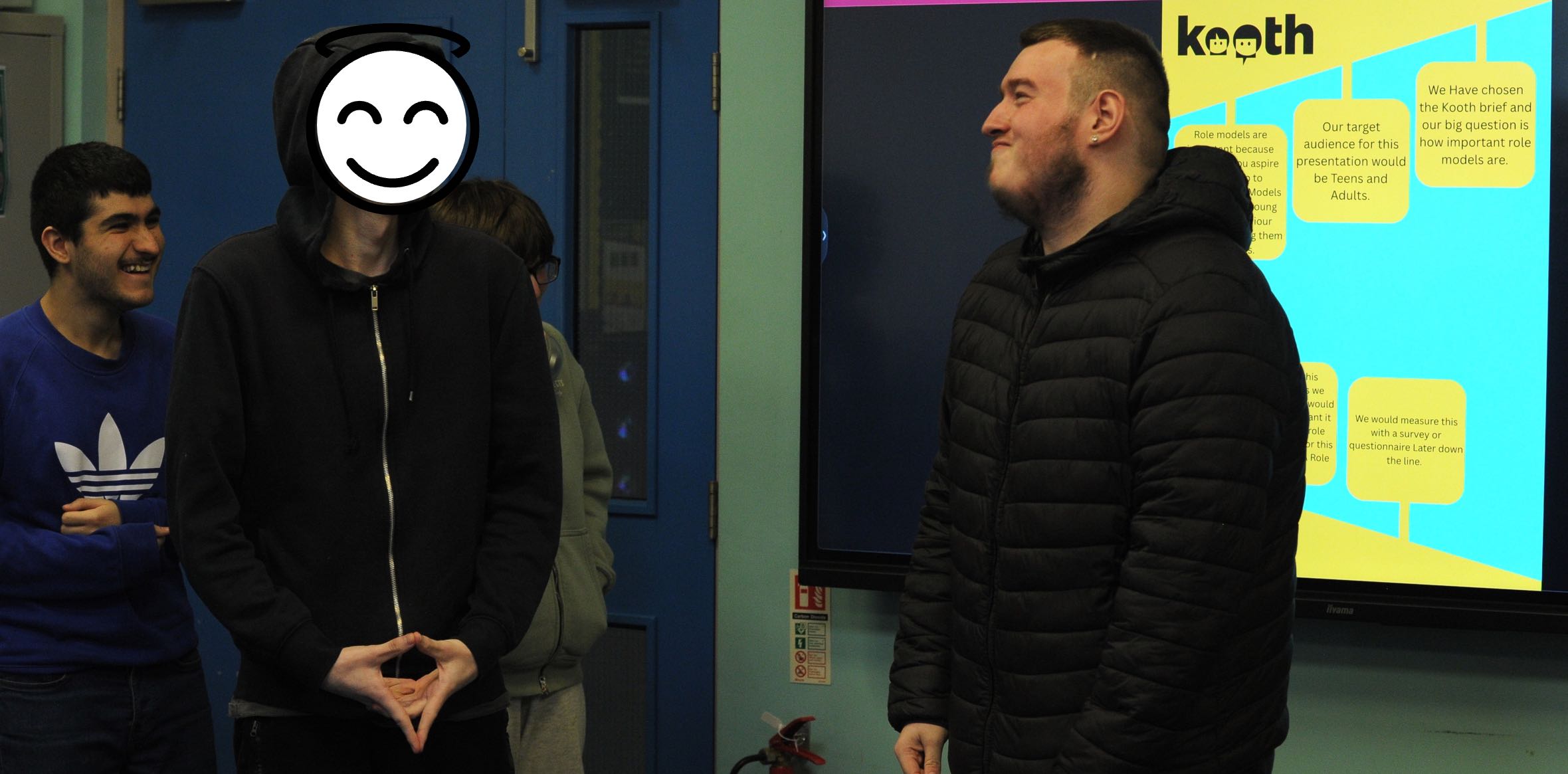
Another group dug into the Kooth brief and came back with a structured argument for why role models matter, who the right audiences are, and how you'd measure whether the message landed.
They weren't polished presentations (although this was the first group in 13 years of doing this that I can actually remember practising their pitch before they pitched it). Some teams were nervous. There was laughter, a fair bit of back-and-forth, and at least one slide featuring a meme of a confused elderly woman at a laptop.
But the thinking was real. The effort was real. The ideas had genuine commercial logic behind them.
The thing I keep coming back to
There's a version of careers education that's essentially broadcast: here's what work is like, here's what employers want, off you go.
That version has its place.
But what I saw at Sheaf Training was something closer to what work actually is. Ambiguous briefs. Incomplete information. A short window to form a view and present it with confidence.
The students who leaned into that - who stopped waiting to be told the right answer and started building their own - were the ones who surprised the room.
One team had clearly absorbed both the brief and the broader problem behind it. They weren't just answering the question; they were reframing it slightly, in a way that made their solution feel more considered. That's not a student behaviour. That's a professional one.

Why this matters for employers
If you're a business wondering whether it's worth investing time in this kind of engagement - it is.
Not because it's a nice thing to do (though it is). But because you get something back.
You get a genuine outside perspective on a real problem. You get to see how people with no assumptions about "how things are done" approach your challenge. And occasionally - more often than you'd expect - you get an idea worth taking seriously.
Story Contracting set a brief about community communication. A group of young people in Sheffield created a concept with a name, a channel strategy, an inclusion plan for non-digital audiences, and a measurement framework. Done in a session. For free.
That's not nothing.

If you want to get involved
We're always looking for organisations willing to share a brief - at any stage of development. It doesn't need to be polished. It doesn't need to have a defined answer. The messier and more real it is, the better the learning tends to be.
Get in touch if you'd like to find out more:
Since we published this...
This post went up on LinkedIn shortly after the session, and Sheaf Training left this in the comments:
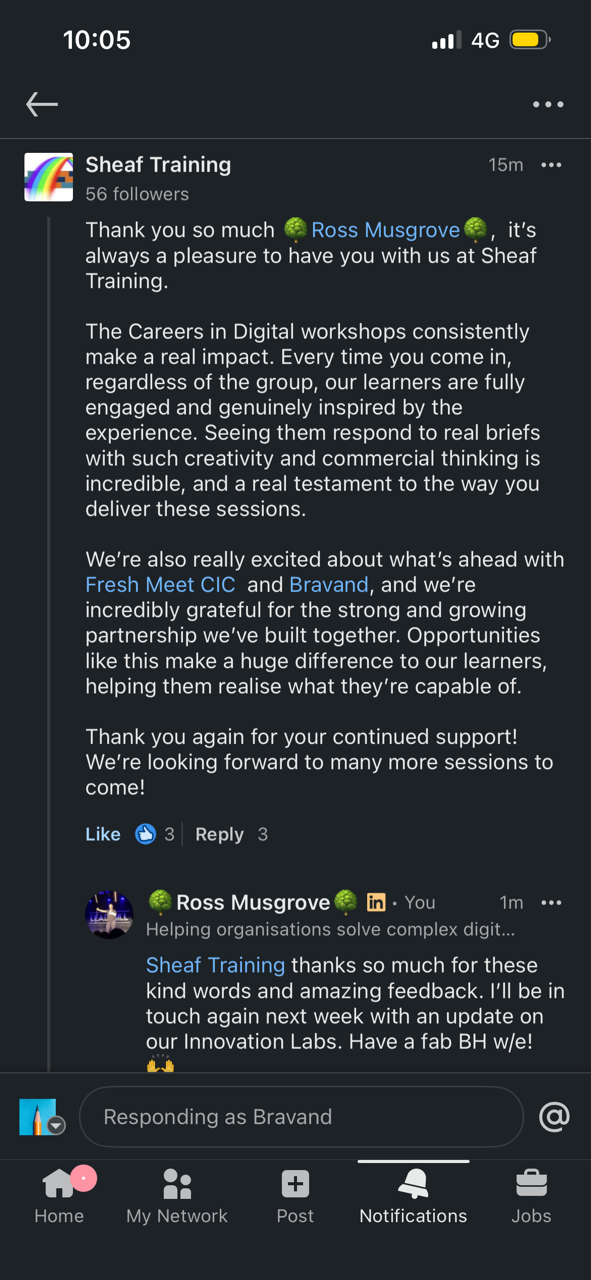
We don't always get to see the ripple effect of these sessions. This was a nice reminder that it lands - not just in the room, but afterwards too.
The thank yous
Thanks to Ellie Cook and Rob McPherson at Sheaf for getting us back in (and feeding me!). We've got a good thing going here, and your learners are always excellent company.
The images used in this article were all captured by Rob McPherson (tutor) and edited by Sam Barber (one of the learners). Sterling job, as always.